Western Arctic Business Association
21 August 2026
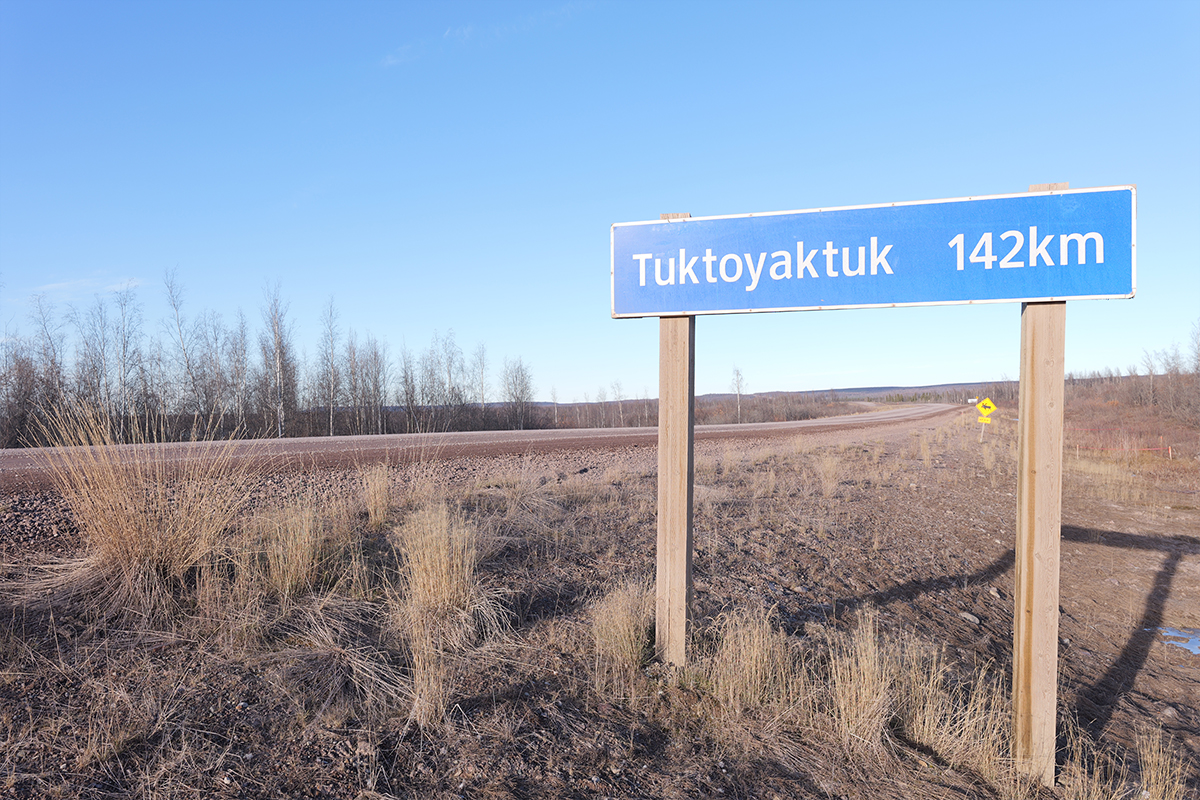
Roadside distance sign for Tuktoyaktuk beside a highway near Inuvik, Northwest Territories, Canada.
When an entire local industry consists of one or two businesses, publishing its performance can mean publishing someone’s books.
Remove the company names, and little changes. In a small community, people can often identify the business from its industry, workforce or circumstances. A supposedly anonymous account of an expansion, funding rejection or hiring problem may identify its owner immediately.
This creates a serious challenge for economic policy in the Canadian Western Arctic. We need evidence that programs work, but conventional ways of reporting that evidence can expose the businesses those programs are supposed to help.
Without an approach suited to these conditions, the smallest markets risk receiving the least scrutiny of the policies shaping their future.
Statistics Canada recognizes the confidentiality problem. Its Rural Canada Business Profiles methodology suppresses figures where too few businesses contribute or where a small number dominate the total. Other figures may also be withheld to prevent readers calculating the missing number by subtraction.
Those protections are necessary. But an unpublished result and an unmeasured result are very different things.
Government can establish objectives, examine protected evidence and assess outcomes without publishing an individual company’s finances. Confidentiality should shape how evaluation happens and what becomes public. It should never become a blanket explanation for why nobody can demonstrate success.
The GNWT’s own documents show why this distinction matters. Its 2026–27 business plan update identified the absence of an evaluation since SEED began in 2008 as the trigger for a scheduled review. It also recorded data-collection difficulties for the Indigenous Capacity Building program and missing performance measurement for Commercial Fisheries Support.
The plan scheduled work to address those gaps. It did not establish that privacy caused them. But it demonstrated that the question of how government evaluates economic development is far from hypothetical.
Spending money, approving applications and completing projects tell us what a program did. They do not, by themselves, tell us what it achieved.
Did supported businesses become more sustainable? Did skilled positions last? Did companies find new customers? Did an eligibility rule prevent an otherwise viable expansion?
These questions become especially consequential where losing one employer can mean losing a local capability altogether.
Aggregation offers only a partial answer. Combining industries, communities or years may make information publishable, but it can also remove the detail needed to understand a problem. A territorial average cannot explain every business model in Inuvik, Tuktoyaktuk or a smaller community.
An emerging industry presents a particular difficulty. Its first business may have no local peers against which to compare performance. Requiring evidence suited to a mature market risks making that business hardest to assess precisely when its development matters most.
Yet the Western Arctic has an advantage that deserves more attention: speaking directly with the businesses affected is feasible.
An independent evaluator could invite every business in a narrowly defined local sector to participate. Structured, confidential conversations could examine operational barriers, application experiences and changes over time.
That engagement should include unsuccessful applicants, owners who never applied and businesses that closed. Evaluating only funding recipients risks overlooking the people a program failed to reach.
Direct engagement still requires discipline. One owner’s experience cannot establish that a policy caused an outcome. But it can identify a problem to investigate, explain an administrative record or reveal a barrier that a broad survey never asks about.
Nor should an evaluator promise anonymity where a distinctive experience would identify its source. Businesses need to understand who will see their information and how it will be used. In some cases, a voluntarily agreed case study may provide a more honest public account than a supposedly anonymous quotation.
Every program should define success before distributing money. It needs a baseline, a review date and clear conditions for changing course. Government’s own delivery belongs in that assessment: processing delays, repeated paperwork and inconsistent decisions can undermine an otherwise useful program.
The public should then receive an account of the evaluation methods, findings that can safely be released, limitations and resulting changes. Where even a summary would identify a business, an independent reviewer should explain what could be verified without disclosing protected details.
There is a practical place to begin. The GNWT’s Access and Privacy Guide describes routine disclosure and formal access requests. Business associations can seek existing targets, evaluation frameworks, completed reports and policies governing withheld results.
That would help establish what government already knows—and where it needs a better way to learn.
A small market makes confidentiality harder. It also makes policy mistakes more expensive.
The Western Arctic cannot afford to spend years supporting, restricting or redirecting businesses without a credible way to establish whether those decisions help them grow.
Western Arctic Business Association
28 March 2026
Western Arctic Business Association
28 April 2026
Western Arctic Business Association
19 May 2026
Western Arctic Business Association
04 September 2026
Government decisions can shape the future of a Northern business for years. In the Western Arctic, remarkably few votes can determine who gets to make those decisions.
25 February 2026
Customers and capable owners are only part of the equation. Northern business support must address the conditions that keep promising companies from becoming sustainable.
15 February 2026
Small businesses are expected to drive northern growth while competing for workers against publicly funded employers with deeper pockets and better benefits.
28 March 2026
Arctic Business is brought to you by the Western Arctic Business Association (WABA)—a member-led organization that supports business growth across the region through partnerships, practical programming, and advocacy on the conditions Northern enterprises need to succeed.