Western Arctic Business Association
06 March 2026
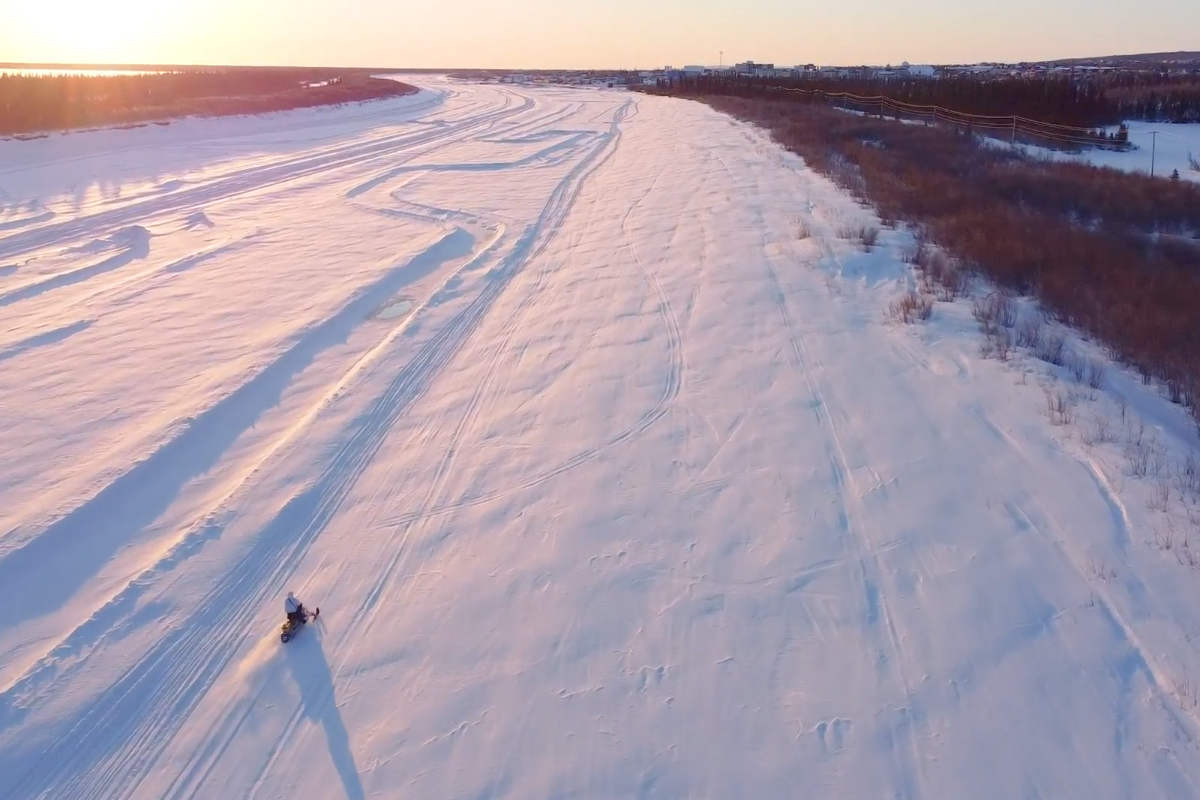
Aerial view of a snowmobile travelling across a frozen river near Inuvik, Northwest Territories, Canada, at sunset.
Government accountability requires someone who can afford to keep asking questions.
In the Canadian Western Arctic, that is a difficult business model. A small population, limited advertising revenue and high operating costs make sustained local journalism expensive to produce and difficult to maintain.
The public need remains, whether the market can support it or not.
Budgets still require examination. Procurement decisions still deserve scrutiny. Projects need to be followed beyond their announcements, and policies need to be judged against what they actually accomplish.
When reporting capacity shrinks, those responsibilities do not disappear. More of them go unattended.
Covering an announcement and examining its outcome are different assignments. The first can produce a story that day. The second may involve documents, repeated interview requests and months of follow-up.
Was the money spent as promised? Did the service improve? Were the jobs sustained? Why has the same problem appeared in another strategy without being resolved?
Those are ordinary questions. Answering them consistently requires resources that a small newsroom may struggle to find.
This is the accountability gap the Western Arctic needs to confront. A publication can continue producing stories while lacking the capacity to pursue the stories that demand the most work. Residents can receive a steady flow of information without receiving enough independent examination of it.
Government communications will explain what government intends to do. Journalism must establish what happened.
The economics become more difficult where government advertising helps sustain the publications responsible for examining government performance. That dependence does not prove interference. It creates a structural vulnerability: scrutiny must remain independent of the institution helping pay for its publication.
Small communities add personal pressure. Difficult reporting can strain relationships that journalists must navigate long after a story appears. That makes editorial backing and financial stability particularly important.
None of this is an indictment of northern reporters. It is an argument for taking their work seriously enough to recognize what happens when they cannot sustain it.
Nor can community discussion reliably fill the gap. A disputed decision may generate hundreds of comments without anyone obtaining the documents, checking the explanation or returning six months later to establish the result.
The standard must apply to everyone exercising influence or making public claims, including businesses and associations such as our own.
The Western Arctic needs reporting with the capacity to persist: to question an announcement, examine an answer and challenge an explanation that does not hold up.
We should judge the health of our media by how much of that work it can sustain.
When nobody can afford to keep asking, institutions face less pressure to explain themselves. The public pays for that silence.
Western Arctic Business Association
05 June 2026
Western Arctic Business Association
06 February 2026
Western Arctic Business Association
02 January 2026
The NWT measures spending, contracts and economic activity in considerable detail. What it does not measure nearly as consistently is whether all of that intervention is producing a stronger private …
04 September 2026
The Northwest Territories has programs that can help people start businesses. What is much less clear is whether those programs are designed to help successful businesses become substantially larger.
07 August 2026
Northern economic development has become very good at funding ideas. The harder question is whether those investments are actually producing durable companies.
03 July 2026
Arctic Business is brought to you by the Western Arctic Business Association (WABA)—a member-led organization that supports business growth across the region through partnerships, practical programming, and advocacy on the conditions Northern enterprises need to succeed.