Western Arctic Business Association
06 February 2026
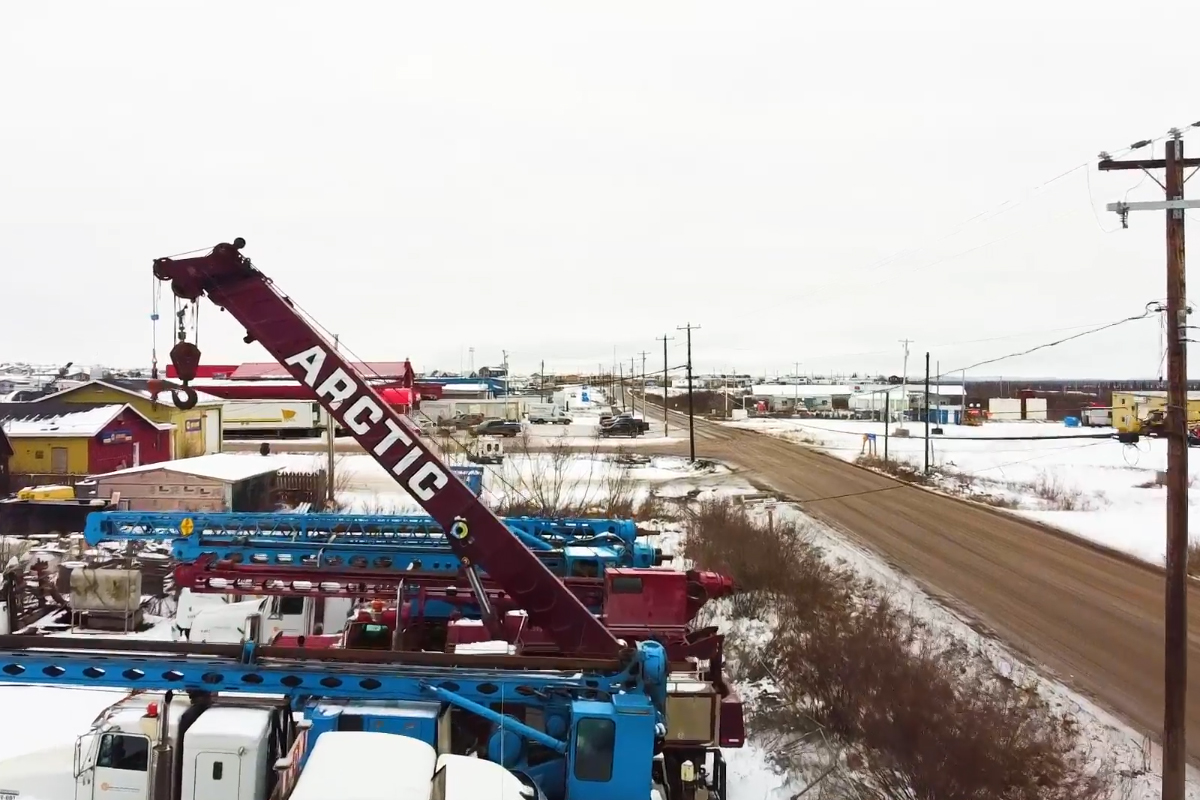
Industrial cranes and heavy equipment at a snow-covered work yard in Inuvik, Northwest Territories, Canada.
The Canadian Western Arctic has spent decades funding economic development, yet we continue to struggle with economic diversification and private-sector growth.
Perhaps the problem is not how much funding is available, but how little actual investment takes place.
Government funding and investment are fundamentally different things. Funding generally pays for an approved activity or project. Investment provides capital to build an enterprise with the expectation of generating future value.
In the Western Arctic, we have become remarkably good at distributing the former while doing relatively little to encourage the latter.
Consider the GNWT’s Support for Entrepreneurs and Economic Development (SEED) program, which offers up to $25,000 through its Entrepreneur Support stream. Other territorial and federal programs provide varying amounts, sometimes substantially more.
These contributions can certainly help small businesses. But $25,000 or even $50,000 does not go particularly far when establishing or expanding a commercial operation. Equipment, premises, employees, inventory and working capital can easily require hundreds of thousands of dollars.
And then there is the administration.
Preparing applications, assembling budgets, obtaining quotations, satisfying eligibility requirements and completing reports can consume weeks of an entrepreneur’s time. For smaller grants, the administrative cost can represent a substantial portion of the funding’s value.
We should be asking whether this is an efficient way to develop an economy.
More importantly, these programs generally fund activities rather than businesses. A feasibility study gets completed, equipment gets purchased or a pilot project gets delivered. Everyone satisfies their reporting obligations, but there is no guarantee that a sustainable business emerges.
A completed project is not necessarily economic development.
In larger markets, businesses have access to private investors, commercial lenders, investment partnerships and other sources of capital. Investors evaluate whether an enterprise can generate revenue, grow and produce a return.
The Western Arctic has far fewer such opportunities. Our small markets, high operating costs and geographic isolation make attracting private capital particularly difficult.
Yet rather than addressing that investment gap directly, we have developed an economic system heavily dependent on government contributions.
This creates some unfortunate incentives.
Entrepreneurs can find themselves pursuing opportunities that qualify for funding rather than those supported by customer demand. Businesses become skilled at writing proposals instead of attracting investment. Economic development becomes measured by dollars distributed and projects completed rather than profitable enterprises established.
Government is already one of the North’s largest employers, customers and sources of economic activity. When it also becomes the principal source of business capital, its policies can effectively determine which commercial activities develop.
That is hardly an ideal foundation for economic diversification.
None of this means government funding is unnecessary. The North faces genuine structural disadvantages that justify public intervention. Nor does it mean that private investment is entirely absent. Indigenous development corporations and established Northern enterprises demonstrate that substantial commercial investment is possible.
But we need mechanisms that turn public funding into lasting productive capacity.
That could include regional investment funds, patient capital, private-sector partnerships and financing arrangements that use public contributions to attract additional investment.
More importantly, we need to change how we measure success.
Instead of counting grants approved and dollars distributed, we should be asking how many sustainable businesses were created, how much private capital was attracted, and how much profit was reinvested in the regional economy.
After decades of economic development programs, the most important question may be the simplest:
What remains when the funding ends?
The Canadian Western Arctic does not necessarily need more funding programs. It needs an economy capable of attracting investment, building productive businesses and eventually financing its own growth.
We have spent decades funding economic development. Perhaps it is time we started investing in it.
Western Arctic Business Association
04 September 2026
Western Arctic Business Association
03 July 2026
Western Arctic Business Association
06 March 2026
Western Arctic Business Association
02 January 2026
Western Arctic Business Association
10 October 2026
The NWT measures spending, contracts and economic activity in considerable detail. What it does not measure nearly as consistently is whether all of that intervention is producing a stronger private …
04 September 2026
The Northwest Territories has programs that can help people start businesses. What is much less clear is whether those programs are designed to help successful businesses become substantially larger.
07 August 2026
Northern economic development has become very good at funding ideas. The harder question is whether those investments are actually producing durable companies.
03 July 2026
Arctic Business is brought to you by the Western Arctic Business Association (WABA)—a member-led organization that supports business growth across the region through partnerships, practical programming, and advocacy on the conditions Northern enterprises need to succeed.