Western Arctic Business Association
12 December 2025
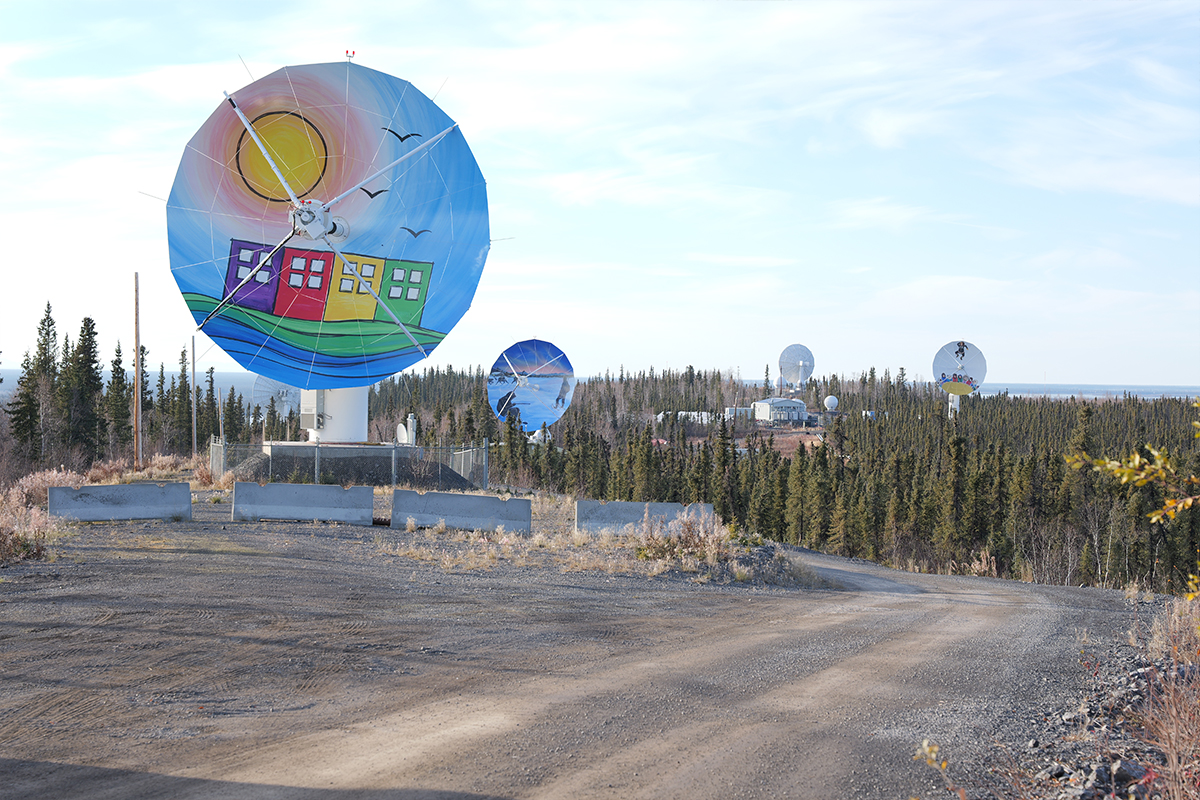
Inuvik Satellite Station Facility (ISSF) government satellite ground station near Inuvik, Northwest Territories, Canada, with large tracking antennas under Arctic sky.
Nobody wants to use CanNor’s business funding—and the reason is not a lack of ambition or ideas. It is because CanNor largely asks entrepreneurs to borrow money they must repay in order to try new things in an economy that government itself helped shape—and constrain.
Northern Canada’s economy is not a typical market economy. It is a system built primarily around government and nonprofit institutions. These entities dominate demand, set norms, and define what is “viable.” But by design, government departments and nonprofits do not take risks. They are accountable to auditors, boards, and voters, not markets. They prize stability, predictability, and compliance over experimentation. Innovation, when it occurs, is incremental and cautious.
This reality matters because entrepreneurship depends on risk. New businesses test unproven ideas, build products before customers exist, and often fail before they succeed. In southern markets, this risk is absorbed by a mix of private capital, early adopters, and competitive pressure. In the North, that ecosystem barely exists. When government is the dominant buyer and nonprofits are the dominant partners, there is little room—and little tolerance—for failure.
Into this environment steps CanNor with loans.
A repayable loan assumes something fundamental: that there is a functioning market ready to reward success quickly enough to service debt. In much of the North, that assumption simply does not hold. The customer base is small. Procurement cycles are slow. Contracts are conservative. Payments are delayed. Growth, if it happens, is gradual. Asking entrepreneurs to take on debt under these conditions is not “supporting innovation”; it is shifting public risk onto private individuals who are least able to absorb it.
The result is predictable. Rational people opt out.
Why would anyone take on debt to build something new when the likely customers—government and nonprofits—are structurally unwilling to buy untested solutions? Why gamble personal financial security to innovate inside an economy that punishes failure but rarely rewards success at scale?
This is not a moral failure on anyone’s part. It is a structural mismatch.
CanNor’s model reflects a southern policy mindset applied to a northern reality. Loans make sense where markets exist. They make far less sense where markets must first be created. In the North, the challenge is not access to capital alone—it is the absence of risk-taking demand. Until that changes, repayable financing will continue to sit unused, regardless of how well-intentioned it is.
If policymakers genuinely want economic diversification in the North, they must rethink what “support” means. Non-repayable grants, pilot procurement programs, guaranteed first customers, and longer-term experimentation funding are not handouts; they are market-building tools. They acknowledge that innovation precedes profitability, not the other way around.
The irony is that government helped create the current economic structure. It can also help reshape it—but only if it accepts that asking entrepreneurs to shoulder all the risk in a risk-averse economy is not entrepreneurship policy. It is avoidance.
Until CanNor’s funding reflects the reality on the ground, northern innovation will remain a talking point rather than a lived experience—and the money meant to catalyze change will continue to go untouched.
Western Arctic Business Association
16 December 2025
Western Arctic Business Association
14 December 2025
PM Mark Carney has announced an estimated $35 billion for defence and Northern infrastructure. The headline number matters—but what will decide the outcome is who writes the rules.
12 March 2026
DND’s April 21, 2026 town hall in Inuvik is the right start. But if Ottawa wants “capacity in the North,” procurement has to build local suppliers—not just local disruption.
28 February 2026
RDII is a welcome signal for the Western Arctic, but Ottawa is still trying to buy defence-ready capacity from a market it never built. Without redesign for market reality, it …
25 January 2026
Arctic Business is brought to you by the Western Arctic Business Association (WABA)—a member-led organization that supports business growth across the region through partnerships, practical programming, and advocacy on the conditions Northern enterprises need to succeed.