Western Arctic Business Association
12 November 2025

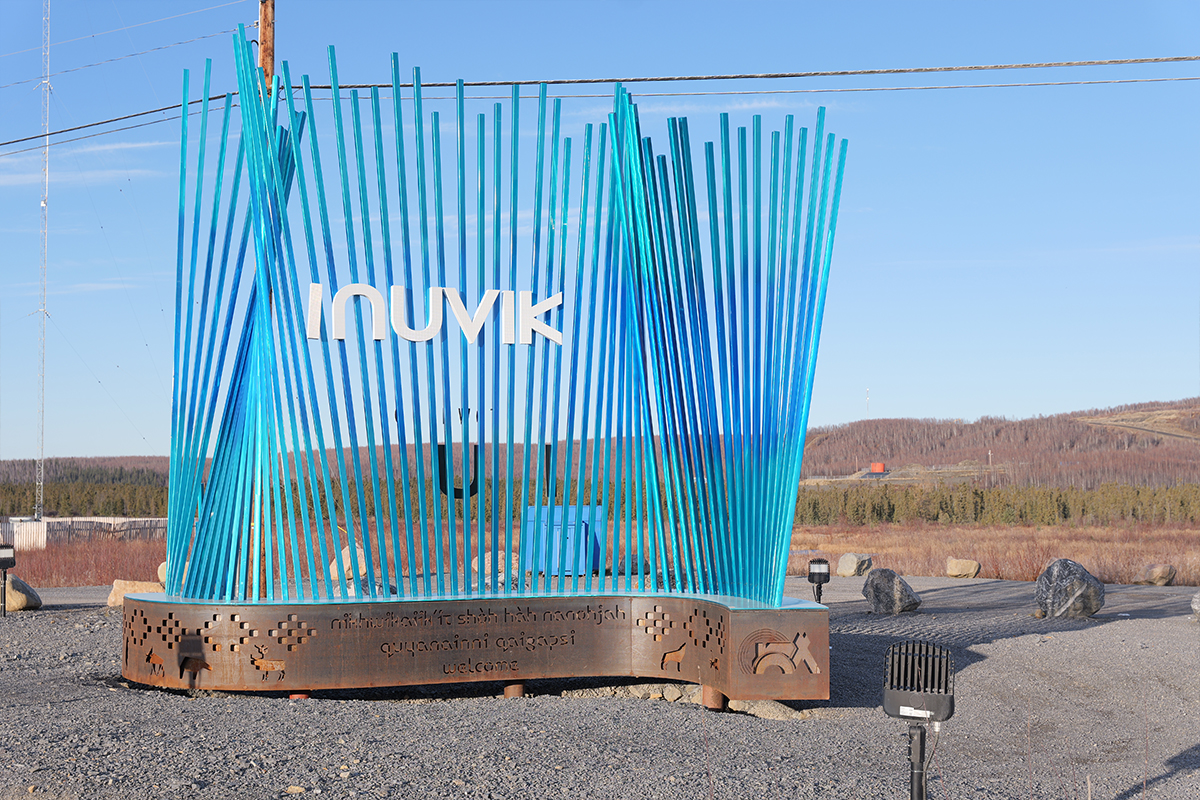
Public art installation near the Inuvik Welcome Centre in Inuvik, Northwest Territories, Canada, showcasing Northern culture and community in an Arctic streetscape.
You already know this, but it bears saying plainly: CanNor’s funding strategy does not make economic sense.
On paper, the agency exists to promote economic development and diversification in the North. In practice, it directs its largest non-repayable contributions to nonprofits, while offering smaller, often repayable funding to private businesses—the very actors expected to create sustainable economic activity. That inversion is not just puzzling. It undermines the agency’s stated purpose.
The North’s economy is already dominated by government and nonprofit institutions. They are the largest employers, the largest buyers, and the primary drivers of demand. These organizations are essential, but they are not engines of market creation. By design, they do not scale, compete, or reinvest profits into expansion. Their success is measured in program delivery, not in economic spillover.
Yet CanNor continues to treat nonprofits as if they are better positioned to drive economic transformation than private firms.
This only makes sense if one accepts a quiet assumption: that economic development in the North is primarily about administering services rather than building markets. Once that assumption is exposed, the logic collapses.
Nonprofits exist to solve defined social or community problems within fixed mandates. They are risk-averse because they must be. Boards, funders, and public accountability mechanisms reward stability, not experimentation. Even when nonprofits run “innovative” projects, those projects are typically pilots that end when funding ends. They rarely generate enduring commercial activity.
Private businesses operate under the opposite conditions. They survive only if they find customers, control costs, and adapt. When they succeed, the benefits compound: jobs persist, skills deepen, suppliers emerge, and tax revenue follows. This is not ideology. It is how economies work.
Given that reality, allocating large, non-repayable funding to nonprofits while asking businesses to accept smaller, risk-laden financing is a strategic contradiction. It assumes that the safest institutions should be entrusted with the most flexible capital, while the riskiest—yet most economically productive—actors should bear the greatest financial exposure.
You can see the outcome everywhere. Nonprofits expand their programming, hire staff for the duration of grants, and then contract when funding cycles end. Businesses, meanwhile, hesitate to pursue new ideas because the downside risk is personal and immediate, while the upside is uncertain and slow. Rational entrepreneurs opt out. They are not failing the system; the system is selecting against them.
None of this requires malice or incompetence to explain. It follows naturally from bureaucratic incentives. Nonprofits are familiar, predictable recipients. Their applications read well, align cleanly with policy objectives, and pose little political risk. Businesses are messier. They fail. They pivot. They do not always deliver neat narratives at the end of a fiscal year.
But economic development is inherently messy. Treating it like a grant-administration exercise does not make it safer—it makes it ineffective.
If CanNor were serious about diversification, its funding logic would be reversed. Large, non-repayable contributions would be used to absorb early-stage market risk in private ventures. Nonprofits would still be funded, but for what they actually do best: service delivery, capacity building, and community support—not market creation.
Right now, the agency is reinforcing the very structure it claims to want to change. It is deepening dependence on institutions that cannot, by design, generate self-sustaining economic growth, while constraining the actors that can.
You don’t need another program to see this. You just need to follow the incentives.
And until those incentives change, no amount of well-intentioned funding will produce the outcome CanNor keeps promising—but never quite delivering.
Western Arctic Business Association
12 March 2026
Western Arctic Business Association
25 January 2026
Western Arctic Business Association
16 December 2025
Western Arctic Business Association
14 December 2025
PM Mark Carney has announced an estimated $35 billion for defence and Northern infrastructure. The headline number matters—but what will decide the outcome is who writes the rules.
12 March 2026
DND’s April 21, 2026 town hall in Inuvik is the right start. But if Ottawa wants “capacity in the North,” procurement has to build local suppliers—not just local disruption.
28 February 2026
RDII is a welcome signal for the Western Arctic, but Ottawa is still trying to buy defence-ready capacity from a market it never built. Without redesign for market reality, it …
25 January 2026
Arctic Business is brought to you by the Western Arctic Business Association (WABA)—a member-led organization that supports business growth across the region through partnerships, practical programming, and advocacy on the conditions Northern enterprises need to succeed.