DND town hall in Inuvik on Northern infrastructure plans
April 21st, 2026 - April 21st, 2026
Midnight Sun Complex, Inuvik, NT
Western Arctic Business Association
28 February 2026
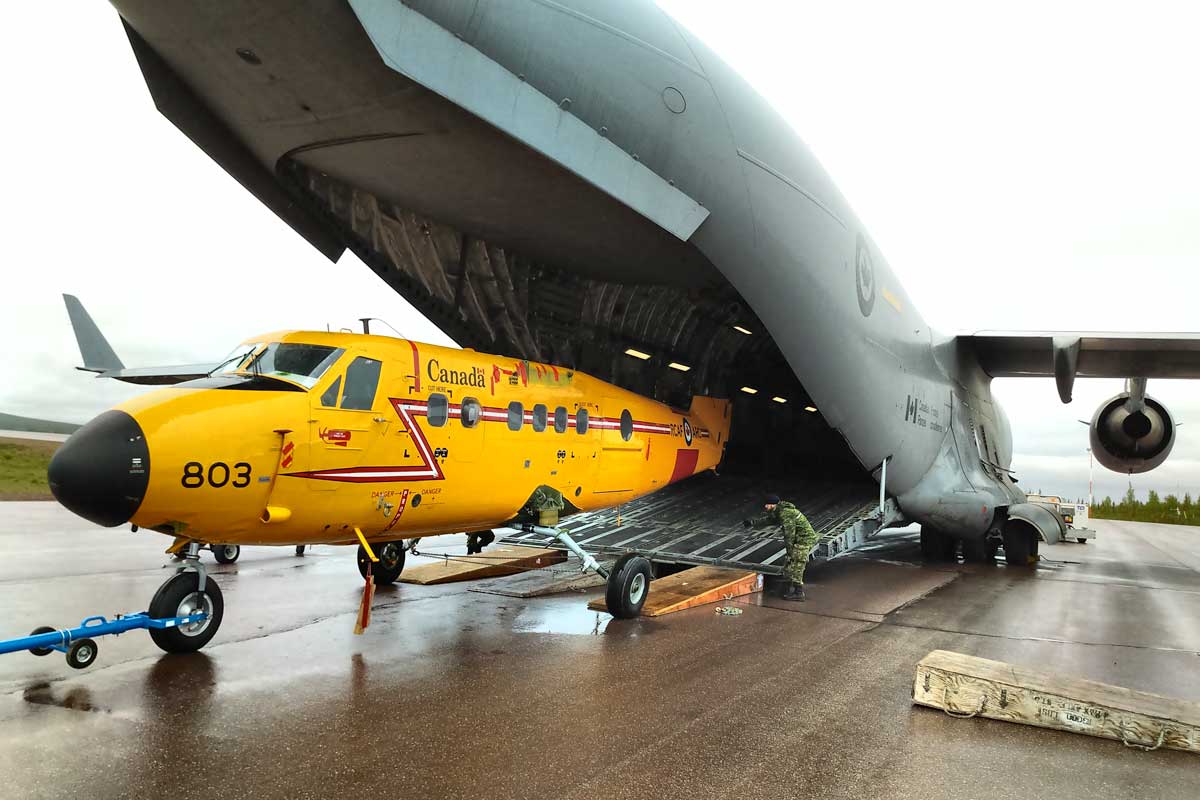
Canadian Armed Forces cargo plane loads a yellow search-and-rescue aircraft in Inuvik, underscoring Northern defence logistics.
The blunt truth is this: big federal infrastructure dollars do not automatically create a local economy—especially in a place like Inuvik.
They can create activity. They can create a short-lived construction surge. They can create a press release. But without deliberate contract design, capital support, and continuity, they will not create durable local producers and suppliers who can meet “military-grade” requirements next time, or even maintain what gets built this time.
That is not a moral argument. It’s a systems argument.
On Tuesday, April 21, 2026 at 6:00 p.m., the Department of National Defence will host a public town hall at the Midnight Sun Complex in Inuvik to share information on planned infrastructure investments to support an expanded Northern presence and capacity, and to hear directly from the community. Residents are also being asked to complete an advance survey, with anonymous responses potentially shared in summary form at the meeting.
This is exactly the right moment to ask the question that too often gets skipped: what is the economic plan that sits underneath the infrastructure plan?
In the Western Arctic, we operate inside constraints that federal procurement routinely treats as rounding errors.
The market is small. The cost base is high. Skilled labour is thin. Shipping and mobilization timelines are long. Private capital is limited. And a large share of local spending flows through government and nonprofit systems that—whatever their social value—do not behave like a commercial market that naturally produces scalable suppliers.
Those conditions don’t make local business unwilling. They make “scale” expensive and risky.
So when DND speaks about expanded infrastructure and capacity, the central issue is not whether Inuvik supports national defence. The central issue is whether DND understands what it is asking local firms to do—and whether it is prepared to structure procurement so that the local response is rational.
Because incentives decide outcomes.
The hidden assumption behind many Northern build-outs is that local capacity is sitting on the shelf—waiting to be “included.”
It isn’t.
Decades of policy choices across all levels of government have produced an economy that is compliance-heavy and capital-light. We have capable operators, but they are asked to grow inside a system that rewards short-term funding cycles and low-bid contracting—while punishing investment in equipment, inventory, certification, and specialized staff.
You can’t ask a local business to become a military-grade contractor with a town hall invitation and a line in an RFP that says “local participation encouraged.”
If the requirement includes bonding, audited financials, documented safety systems, security clearances, specialized training, and rapid mobilization in a harsh environment, then the question becomes blunt: who pays for the ramp-up?
DND is incentivized to deliver projects on time, on spec, and defensibly—meaning in a way that survives internal review, external audit, and political scrutiny. That tends to favour large southern firms with compliance infrastructure, strong balance sheets, and procurement experience.
Prime contractors are incentivized to reduce risk. They will bring established subcontractors. They will consolidate work into fewer packages. They will minimize unknowns. They will treat “local” as a reputational benefit, not an operational dependency—unless the contract makes local capacity a condition of performance.
Local businesses are incentivized to protect themselves. When contracts are short, irregular, and loaded with compliance costs, the rational move is to stay small, subcontract at the margin, or pass entirely. Scaling up means taking on debt, hiring scarce labour, and buying equipment that may have no viable use when the surge ends.
Workers are incentivized to chase stability and wages. In a tight labour market, a sudden influx of high-paying, short-duration work pulls people from existing employers and essential services. When the project ends, the community is left with layoffs, weakened local operations, and a deeper skepticism about the next “opportunity.”
None of this is anyone “being difficult.” It is what a small market does when a big buyer arrives with big timelines and limited follow-through.
If DND treats Inuvik as a project site rather than an economy, the costs won’t show up neatly in a budget line.
They show up as missed market formation: local firms remain perpetual subcontractors rather than prime-capable suppliers.
They show up as trust loss: community participation starts to feel like consultation theatre.
They show up as capacity whiplash: businesses are pressured to build up for a one-time contract, then contract afterward—layoffs, idle assets, and a reluctance to take the next risk.
They show up as resilience loss: when the next emergency, maintenance cycle, or strategic need arrives, the North is again dependent on fly-in capacity.
If the strategic goal is “presence and capacity in the North,” it is self-defeating to build infrastructure while leaving the local economic base unchanged.
If DND wants a stronger Western Arctic, it should behave like an anchor customer building a supply chain—not a one-off buyer shopping for the lowest-risk delivery.
Start with transparency and sequencing. Publish a multi-year pipeline that local firms can plan around: what is coming, when, and what standards will apply. Northern businesses can meet high standards, but they cannot do it on surprise timelines.
Design contracts for capacity-building, not just completion. Break work into packages sized for local firms to prime, not only sub. Use phased procurement that rewards demonstrated growth: pre-qualification, smaller initial scopes, then larger scopes as performance is proven.
Build continuity into the deal. The worst model is “build fast, leave, and let local firms eat the overhead.” If DND infrastructure is going to exist in Inuvik, then operations and maintenance must be part of the procurement strategy from day one: multi-year service contracts, local maintenance requirements, and training embedded into delivery.
And if DND needs military-grade outcomes, it must support military-grade readiness. That means enabling certification, safety systems, quality management, and security processes—not as unfunded expectations, but as part of the project architecture.
This is not protectionism. It is risk management—and it is how you create dependable Northern capability that reduces future risk for DND and for Canada.
On April 21, the community should be asking questions that force procurement clarity:
Will DND structure procurement so local firms can prime meaningful scopes of work, not just provide token subcontracts?
What is the plan to help local businesses meet compliance, bonding, and certification requirements that DND work entails?
What continuity will exist after the initial build so scaling up doesn’t end in layoffs and idle assets?
If DND is serious about a sustained presence, it should be equally serious about a sustained local supplier base. Otherwise, the North becomes a stage where projects happen, not a place where an economy grows.
Western Arctic Business Association
25 January 2026
Webhorse Technologies - IT Services in Inuvik
28 December 2025
RDII is a welcome signal for the Western Arctic, but Ottawa is still trying to buy defence-ready capacity from a market it never built. Without redesign for market reality, it …
25 January 2026
Local procurement rules exist for a reason. So why are Arctic contracts still going south? The hidden costs show up in jobs, capacity, and trust.
14 December 2025
If the goal is a real Northern economy, CanNor’s funding logic is backwards. This piece explains why—and what a better model looks like.
12 November 2025
Arctic Business is brought to you by the Western Arctic Business Association (WABA)—a member-led organization that supports business growth across the region through partnerships, practical programming, and advocacy on the conditions Northern enterprises need to succeed.