Western Arctic Business Association
25 January 2026
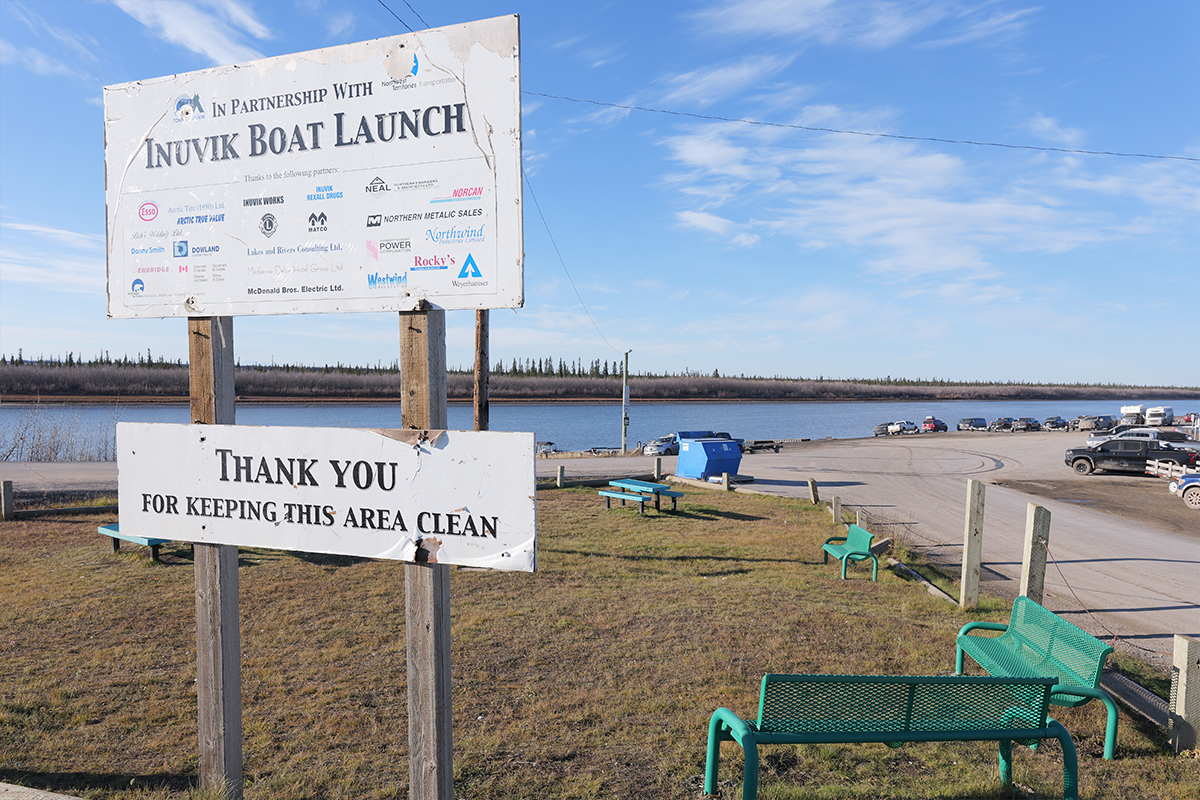
Boat launch on the Mackenzie River East Channel in Inuvik, Northwest Territories (NT), Canada, showing the launch area and river channel.
Ottawa can’t procure resilience from an economy it didn’t finance into existence.
The Regional Defence Investment Initiative (RDII)—$357.7 million nationally through Regional Development Agencies, with CanNor delivering up to $40.5 million across Nunavut, the NWT and Yukon over three years starting 2025–26—is a welcome signal and necessary if Canada is serious about defence capacity in the North.
Businesses and communities in the Western Arctic want to participate. They also understand sovereignty isn’t abstract. It runs on logistics and infrastructure, on maintenance and communications, and on people who can deliver under pressure.
But Ottawa’s delivery model still assumes something the North does not have: scale. Ottawa keeps designing for an economy it wishes existed in the Western Arctic, not the one that does.
Start with the market. Northern economies run small. Public and nonprofit spending sets the pace, private capital remains limited, and most firms operate lean. Owners don’t just manage projects; they carry HR, safety, payroll, and bidding in the same week. Labour is expensive to recruit and retain. Advanced skills take time to build—and longer to keep. Timelines stretch accordingly. These aren’t side issues. They decide whether local enterprise can show up at all.
That’s why so many northern programs land the same way. They’ll fund pilot projects, some start-up costs, and some training—yet they still sidestep the hardest constraint: the ability to scale.
Ottawa’s program logic rarely starts from these realities. It starts from a southern template: announce funding, run an application process, require compliance, and expect the market to respond quickly. The assumption is always the same: demand is the main constraint, so money will create suppliers. In practice, Ottawa tries to compress decades of market-building into program timelines measured in months.
In the Western Arctic, demand isn’t the only constraint. Depth is. Without skilled labour, management capacity, equipment, balance sheets, compliance systems, and time, businesses can’t scale no matter how attractive the funding looks.
Thin markets add another reality Ottawa’s templates rarely reflect: in many sectors, the local economy barely sustains one capable operator. Import “competition” requirements from larger economies and you don’t broaden the field. You can exclude the only firm that can actually deliver.
Decades of policy help explain why that depth is missing. Governments have funded service delivery more consistently than market formation. Social programs, nonprofits, and cultural institutions play essential roles in northern life—but that funding mix leaves too little sustained support for training pipelines, trade pathways, productive enterprises, and the conditions that let firms grow into larger, more capable businesses.
That difference matters in a thin market. Nonprofits and public institutions keep communities functioning, but they are not structured—or funded—to build scalable production capacity.
RDII now asks northern businesses to behave like southern suppliers—bid, staff up, certify, manage reporting, and meet readiness timelines—without comparable supports. At that point, the incentives take over.
Ottawa wants delivery that shows progress and avoids procurement risk. CanNor must run the program inside federal rules rather than rewrite them. Local firms, meanwhile, operate with limited staff time; many don’t have capacity to write applications and manage reporting, let alone navigate government contracting and defence procurement. National contractors do—and they already know how to win government work.
That combination produces a familiar pattern: work flows to established players, while homegrown firms—including those already supporting northern operations—participate at the margins through subcontracts, short-term hires, and “engagement” roles, without building durable local capability.
If Ottawa insists on speed under the current rules, there are only two outcomes: the program fails to meet its own objectives and gets redesigned later, or the work shifts—quietly and inevitably—to national firms that can mobilize now.
The costs compound. Businesses stop applying when they can’t compete on the terms set for them. Career ladders don’t form. The supplier base doesn’t deepen. Ottawa remains reliant on outside capacity for northern operations—the opposite of what the program says it wants.
If Ottawa wants real northern defence capability, it has to reverse the sequence. It needs to build suppliers before it tries to buy from them.
That means funding what actually determines scale: multi-year labour and skills pipelines tied to predictable work; procurement packaging that lets local firms lead meaningful scopes without getting crushed by compliance; and support for certifications, safety systems, and bid capacity that count as “overhead” in the South but operate as barriers to entry in the North. Ottawa also needs to aggregate demand across departments and years, rather than scatter it across one-off calls that never justify investment.
It also has to accept a northern truth: in many sectors, the market can’t sustain multiple competitors. Designs that assume a thick competitive field will exclude the only viable providers.
RDII is a good signal. But signals don’t build supply chains.
Defence readiness isn’t an announcement. It’s a supplier base—and the North was never funded to grow one.
Western Arctic Business Association
12 March 2026
Western Arctic Business Association
28 February 2026
Inuvik Web Services - Cloud Provider in Inuvik
16 January 2026
Western Arctic Business Association
14 December 2025
PM Mark Carney has announced an estimated $35 billion for defence and Northern infrastructure. The headline number matters—but what will decide the outcome is who writes the rules.
12 March 2026
DND’s April 21, 2026 town hall in Inuvik is the right start. But if Ottawa wants “capacity in the North,” procurement has to build local suppliers—not just local disruption.
28 February 2026
Local procurement rules exist for a reason. So why are Arctic contracts still going south? The hidden costs show up in jobs, capacity, and trust.
14 December 2025
Arctic Business is brought to you by the Western Arctic Business Association (WABA)—a member-led organization that supports business growth across the region through partnerships, practical programming, and advocacy on the conditions Northern enterprises need to succeed.