Inuvik Web Services - Cloud Provider in Inuvik
16 January 2026
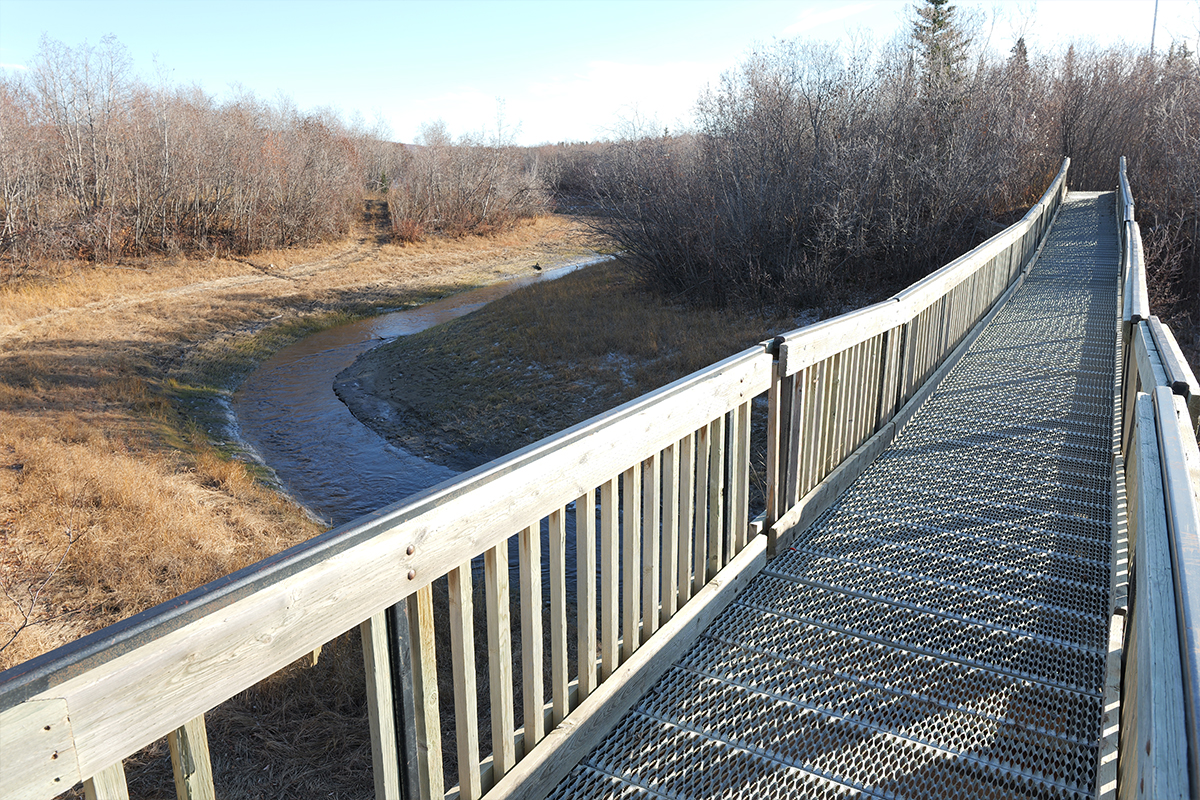
Wooden bridge on Boot Lake Trail in Inuvik, Northwest Territories—one of many local trails weaving through boreal forest, lakes, and wetlands around town.
In the Western Arctic, “cloud services” don’t sit in the background as a convenience layer. They sit in the middle of operations. Domains, email, and web infrastructure are how organizations stay reachable, how programs communicate, how communities verify information, and how institutions maintain continuity across years—not just across billing cycles.
That reality shapes what Northern cloud providers are.
Southern hyperscalers and venture-backed SaaS platforms are designed for scale. Their strength is consistency across millions of customers: standardized products, self-serve administration, and support models built around policies that must apply broadly. DIY platforms take the same idea to its logical end—low-cost tools that assume the customer has stable internal capacity to manage ownership, renewals, access, and transitions.
Those models work well in the environments they were designed for.
Northern providers are built for a different operating reality: smaller organizations, thinner administrative bandwidth, higher turnover, and funding cycles that can be episodic or delayed. Under those conditions, the primary risk isn’t whether a tool exists—it’s whether the organization can keep control of its digital identity and keep services intact when roles change.
That’s why Northern cloud service is less about features and more about continuity.
A Northern provider designs for the moments that are routine here and “edge cases” elsewhere: governance transitions, staffing changes, pauses in capacity, and the practical handover of access and responsibility. The value is often invisible on a feature list because it shows up as the absence of crisis: fewer avoidable outages, fewer rebuilds, fewer situations where an organization’s public presence becomes disconnected from its ability to operate.
Recognizing this difference matters for community outcomes as much as for vendor selection.
When funding agencies and procurement teams treat cloud as a commodity and benchmark primarily against hyperscaler pricing or DIY subscriptions, they’re using the wrong yardstick. They’re comparing a mass-market infrastructure product—priced and supported for volume—to a continuity-focused service built for Northern conditions. On paper, both can look like “hosting.” In practice, they behave very differently when an organization needs stability through turnover.
Policy and procurement decisions then ripple outward. If funding is structured around one-time builds rather than ongoing continuity, the predictable pattern is launch, drift, and rebuild. If evaluation focuses on the lowest visible monthly price, it can unintentionally discourage the very local capacity that reduces risk and keeps services resilient over time. The community doesn’t just lose “a provider option.” It loses a model of service that is designed around Northern operating realities.
This is not a call to reject hyperscalers or DIY tools. They have their place, and many Northern organizations will keep using them. The point is that they are not the same thing as a Northern continuity model—and shouldn’t be evaluated as if they are.
A better policy question is simple: what outcomes are we trying to protect?
If the goal is resilient community service delivery, then cloud procurement needs to value governance, continuity, and accountability—who carries the risk when people change, when capacity is thin, and when timelines slip. That’s the basis for sound comparisons and durable decisions.
In the Western Arctic, local cloud providers exist to make digital infrastructure behave like community infrastructure: steady, accountable, and built to survive real-world turnover. Recognizing that difference isn’t about preference. It’s about aligning policy and purchasing with how Northern organizations actually operate—and protecting the continuity communities increasingly depend on.
Western Arctic Business Association
25 January 2026
Western Arctic Business Association
06 January 2026
In the Arctic, the limiting factor is often not capability—it’s discoverability and verification, and that friction quietly distorts how the region functions.
25 December 2025
From local fraud and service outages to state-driven targeting of infrastructure and resources, cyber risk in the Canadian Arctic is now a strategic and operational issue—not a back-office one.
28 December 2025
The space economy has moved from guarded capability to commercial infrastructure. Canada’s national interest now is to compete—and our rules haven’t caught up.
22 December 2025
Arctic Business is brought to you by the Western Arctic Business Association (WABA)—a member-led organization that supports business growth across the region through partnerships, practical programming, and advocacy on the conditions Northern enterprises need to succeed.