Webhorse Technologies - IT Services in Inuvik
28 December 2025
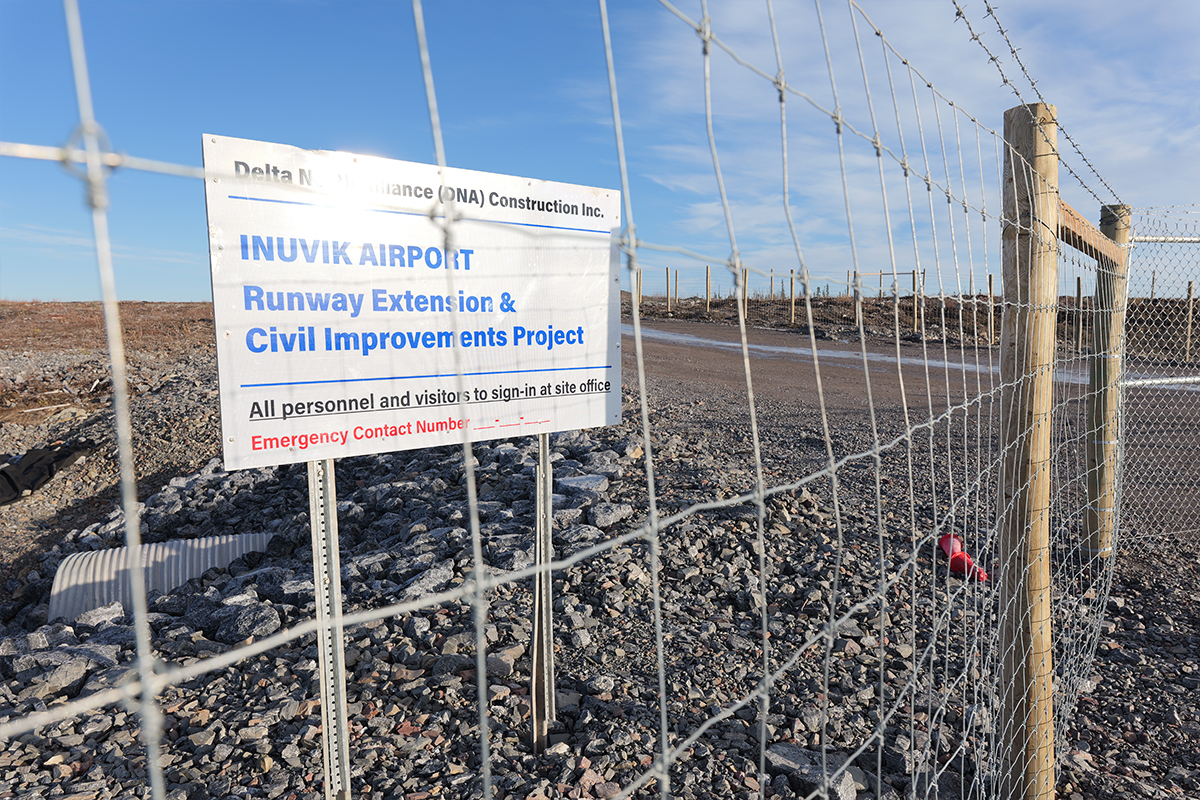
Airport expansion project underway at Inuvik Mike Zubko Airport in Inuvik, Northwest Territories, Canada, supporting regional transportation and economic activity in the Western Arctic.
In the Canadian Arctic, the distance between a suspicious email and a real-world consequence is short. A compromised inbox can redirect payments, interrupt service delivery, or slow decision-making at the exact moment a community needs speed and clarity. That’s the local face of the problem.
But it’s no longer the whole story. Cybersecurity in the Arctic now sits on a straight line from day-to-day business disruption to international competition and national security. When a region becomes strategically valuable—because of critical minerals, energy, research, sovereignty infrastructure, and emerging shipping routes—it also becomes strategically targeted. Cyber is one of the lowest-cost ways to gather intelligence, influence outcomes, and probe resilience without crossing a physical border.
That is the core reality: the Arctic is being digitized faster than it is being secured, and the threat environment is upgrading faster than governance and procurement.
At the local level, the most common threats are familiar: phishing, impersonation, support scams, credential theft, and ransomware pressure. These attacks increasingly look legitimate because criminal ecosystems have matured into a marketplace—tools, access, and tactics are bought and sold, lowering the barrier for sophisticated campaigns. The result is a steady, persistent pressure against organizations that rely heavily on email, cloud tools, and remote support.
At the community level, cyber risk is also a trust issue. Northern economies and service systems run on relationships—between suppliers and buyers, between programs and recipients, between community institutions and residents. Social engineering works best where trust and urgency coexist. That makes vulnerable populations—especially Elders and youth—attractive targets for scams designed to create panic, extract money, or harvest personal information that can be reused elsewhere.
At the territorial and infrastructure level, the problem expands again. Arctic operations depend on networks that connect critical functions: power, communications, transportation logistics, and public services. Connectivity improvements and modern remote monitoring expand capability, but they also expand the attack surface. In many sectors, operational technology—systems that monitor or control physical processes—was not built with today’s adversaries in mind. The more these systems are connected, the more they inherit the full spectrum of internet-era threat.
At the national level, the Arctic is part of a wider pattern: state-aligned and state-sponsored cyber activity targeting critical infrastructure, government systems, research ecosystems, and strategic industries. The motivation is not only theft of data. It includes positioning—understanding what Canada knows, what Canada can do, where Canada is brittle, and how public narratives around major projects and sovereignty can be influenced. In a region where project timelines and public confidence matter, the information environment becomes part of the operating environment.
At the international level, the Arctic is where cyber, influence, and supply chains converge. Modern systems are assembled from global components—software, managed services, network appliances, cloud platforms, and contractors. That creates efficiency, but it also creates dependency and concentration risk. A supply chain compromise, a widely used vulnerability, or a vendor-side incident can affect many organizations at once. In the Arctic, where redundancy is limited and specialist support is often remote, these events can have outsized operational impact.
This is why the old framing—cybersecurity as a technical program, managed mostly inside IT—is no longer adequate. The risk is now board-level and government-level because it directly affects continuity, public confidence, and strategic competitiveness. The right question is not “Are we compliant?” It’s “Can we keep operating when something fails—and who is accountable when it does?”
The problem is also intensified by a mismatch between threat speed and institutional speed. Adversaries iterate quickly. Procurement cycles, funding models, and contracting norms move slowly. Organizations can end up modernizing their digital operations—moving to cloud tools, enabling remote access, connecting systems—without a parallel modernization of accountability: response commitments, recovery expectations, vendor obligations, and lifecycle management for aging technology.
Cybersecurity in the Arctic, in other words, is becoming a governance test. It tests whether we can build digital capability without quietly importing fragility. It tests whether contracts buy outcomes or simply buy tools. And it tests whether public policy treats cyber resilience as essential infrastructure, not discretionary overhead.
The path forward starts with treating cyber resilience as an operational requirement, not an IT feature. That means procurement and funding that prioritize measurable continuity: defined response and recovery expectations for critical services; clear vendor obligations when third-party tools and access are involved; lifecycle requirements that prevent end-of-life systems from becoming permanent exposure; and sustained support to build local capacity so prevention and response are not always dependent on distant availability. The Arctic will remain a target. The practical goal is to reduce the payoff for attackers and reduce the downtime cost for communities.
Western Arctic Business Association
28 February 2026
Western Arctic Business Association
06 January 2026
Western Arctic Business Association
01 September 2025
Western Arctic Business Association
16 December 2025
Northern cloud providers aren’t a smaller version of southern platforms—they’re built around continuity, turnover, and community operating realities.
16 January 2026
In the Arctic, the limiting factor is often not capability—it’s discoverability and verification, and that friction quietly distorts how the region functions.
25 December 2025
The space economy has moved from guarded capability to commercial infrastructure. Canada’s national interest now is to compete—and our rules haven’t caught up.
22 December 2025
Arctic Business is brought to you by the Western Arctic Business Association (WABA)—a member-led organization that supports business growth across the region through partnerships, practical programming, and advocacy on the conditions Northern enterprises need to succeed.